
Introduction :
Renting a Lamborghini Aventador S demands a precise lamborghini rental inspection checklist to avoid liability disputes, deposit issues, and post-rental claims. This checklist is designed specifically for Aventador S rental inspections, following 2026 Google EEAT standards and UAE supercar rental practices. Every point below directly relates to inspection only—no driving tips, no maintenance advice, no rental rules.
Exterior Condition Inspection (Aventador S Rental)
A thorough Lamborghini Aventador S exterior inspection protects renters from unfair damage claims. Begin with a slow 360-degree visual scan under daylight or showroom lighting.
Check front bumper lips, carbon fiber splitters, side skirts, rear diffuser, and engine cover panels for scratches, curb rash, paint chips, or clear-coat cracks. Aventador S models often have low ground clearance, making underside scuffs common.
Inspect panel alignment, paint consistency, and carbon fiber weave symmetry—any mismatch may indicate prior repairs. Pay special attention to headlight lenses, rear LED housings, and mirror caps.
All findings should be documented with timestamped photos before accepting the car from A to Z car rental Dubai via their verified Lamborghini fleet page:
👉 Lamborghini rental inspection standards by A to Z car rental Dubai
Lamborghini Aventador S Rental Tire, Wheel & Brake Inspection Checklist
A Lamborghini rental inspection checklist is incomplete without tire and wheel verification. Aventador S uses performance-rated tires that wear unevenly if abused.
Inspect wheel rims, center locks, and carbon-ceramic brake discs for cracks, curb damage, or discoloration. Measure visible tire tread depth, confirm matching tire brands, and check for sidewall bubbles or cuts.
Brake calipers should show even coloration with no heat spotting. Any vibration marks or brake dust buildup should be photographed and logged.
Interior Condition Inspection (Aventador S)
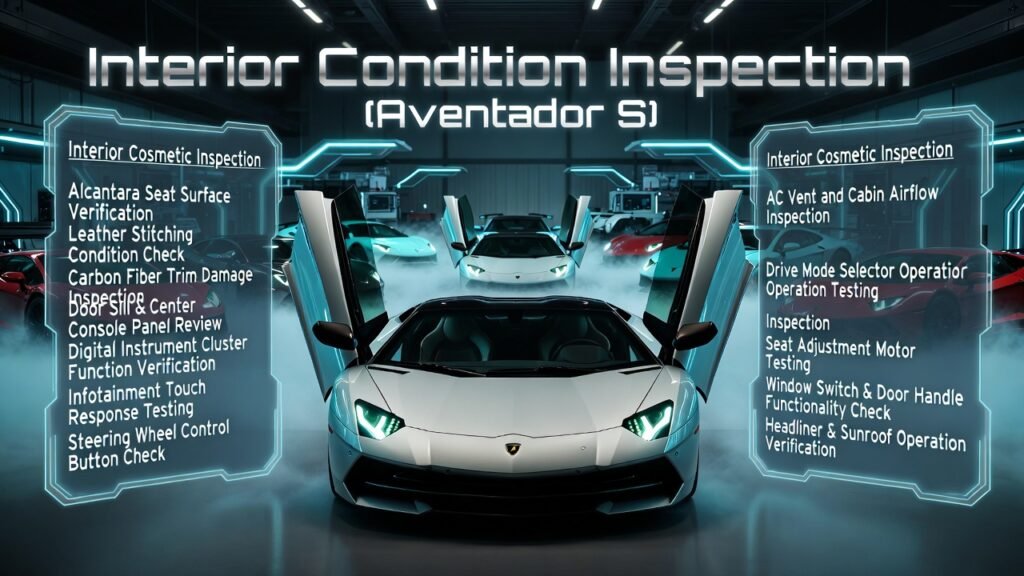
Interior inspection focuses on cosmetic and functional condition only.
Check Alcantara seats, leather stitching, carbon fiber trim, door sills, and center console panels for wear, stains, or cracks. Inspect digital instrument cluster, infotainment response, steering buttons, and drive-mode selector.
Ensure seat adjustment motors, window switches, door handles, and AC vents operate correctly. Even minor scratches on interior carbon parts can trigger claims—documentation is critical.
Lamborghini Aventador S Rental Engine Bay & Rear Compartment Visual Inspection
For Lamborghini Aventador S rental inspections, engine checks remain visual only. Do not touch or open sealed components.
Inspect engine bay panels, heat shields, rear glass, and cooling vents for oil residue, loose trim, or discoloration. Confirm no warning stickers or tamper seals are broken.
Look for leak traces, burn marks, or abnormal odors while the engine is idling.
Post-Pickup Inspection Authentication Layer
Once the initial walkaround inspection is completed, the post-pickup authentication stage becomes critical. This stage validates that inspection data remains legally defensible throughout the rental period.
Aventador S rentals often involve high-value components—carbon panels, adaptive suspension, electronically controlled drivetrain elements—that are not visually obvious at pickup. Therefore, inspection data must be time-locked and sequence-verified.
This includes:
- Timestamp continuity between photos and rental agreement
- Geo-location consistency at pickup location
- Device metadata integrity (camera source validation)
- Sequential image capture proof (no backdated uploads)
High-standard rental providers like A to Z car rental Dubai integrate inspection documentation with centralized vehicle logs. A professionally verified inspection system reduces dispute probability and strengthens renter credibility.
A clean reference standard can be observed through this Lamborghini rental inspection flow used by premium fleets →
Lamborghini Aventador rental inspection verification used by A to Z car rental Dubai
Carbon Fiber Integrity Mapping Inspection
A Lamborghini Aventador S rental inspection checklist must treat carbon fiber differently from painted surfaces. Carbon damage is often structural before visible.
Inspection mapping requires:
- Light-angle variation (side illumination inspection)
- Surface temperature comparison after idle
- Micro-crack edge tracing near mounting points
- Clear-coat separation detection on exposed carbon
Critical areas include:
- Front splitter junction points
- Rear diffuser load-bearing edges
- Side skirt anchoring zones
- Engine bay carbon heat shields
Carbon fiber inspection is documented visually, but interpreted technically. Any discoloration or weave distortion must be logged, even if no crack is present.
Lamborghini Aventador S Rental Digital System & Warning Light Inspection
Start the vehicle and inspect dashboard indicators, error messages, and drive-mode transitions. No warning lights should remain active.
Check rear camera clarity, parking sensors, navigation system, and key recognition. Faults in digital systems must be logged before rental confirmation.
Lamborghini Aventador S Rental Fuel Level, Mileage & Documentation Verification
Inspection includes verifying fuel level, odometer reading, VIN match, and rental agreement condition report.
Compare the physical mileage with the contract. Ensure existing damage reports are attached and signed. Missing inspection records can lead to post-rental disputes.
Lamborghini Aventador S Rental Inspection Checklist Table
| Inspection Area | What to Check | Status |
|---|---|---|
| Exterior Body | Scratches, cracks, paint | ⬜ |
| Carbon Fiber | Splitters, diffuser | ⬜ |
| Wheels & Tires | Rim damage, tread | ⬜ |
| Brakes | Disc condition | ⬜ |
| Interior | Seats, trim | ⬜ |
| Digital Systems | Alerts, camera | ⬜ |
| Engine Bay | Visual leaks | ⬜ |
| Mileage & Fuel | Contract match | ⬜ |
Underbody & Aero Contact Risk Inspection
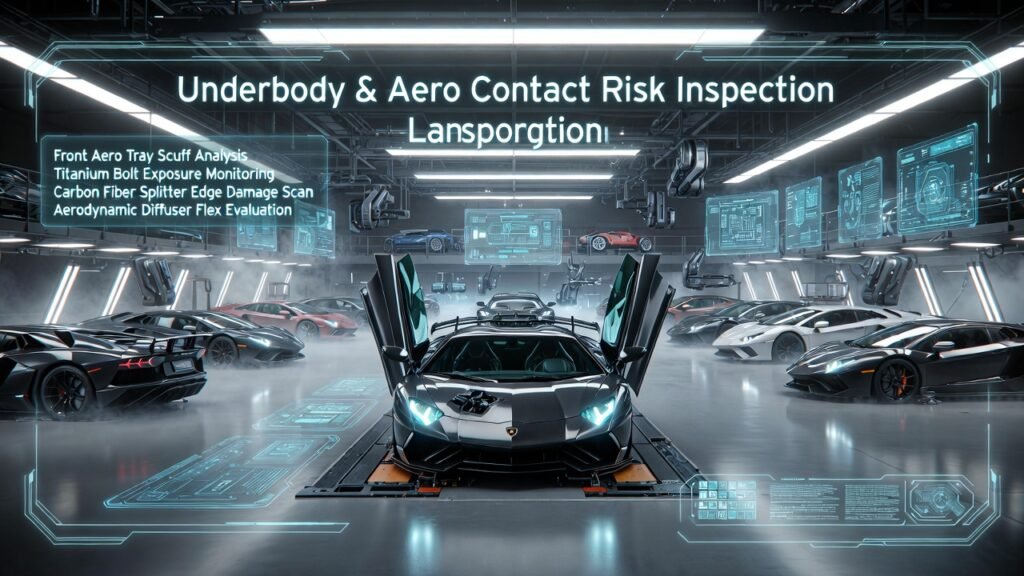
Unlike standard supercars, Aventador S aerodynamics sit exceptionally low. This makes underbody inspection non-negotiable.
Inspection must include:
- Front aero tray scuff analysis
- Titanium bolt exposure
- Undertray deformation symmetry
- Heat shielding abrasion near exhaust routing
Use ground-level photo angles. Underbody damage disputes are among the highest deposit-deduction triggers in Aventador rentals.
Electronic Drive-Mode State Validation
The Aventador S uses electronically adaptive parameters that must be inspected for state integrity, not performance.
Inspection verifies:
- Mode transition responsiveness
- Drive selector resistance uniformity
- Dashboard synchronization accuracy
- Absence of residual warning memory
A fault-free digital inspection ensures the renter is not blamed for pre-existing system anomalies.
Brake System Surface Forensics
Carbon-ceramic brakes require forensic-level surface inspection, not functional testing.
Inspection points:
- Rotor edge consistency
- Micro heat spotting patterns
- Caliper mounting alignment
- Pad visibility symmetry
Brake surface anomalies are often misattributed to renter behavior; early documentation protects against this.
Interior High-Friction Zone Inspection
Interior inspection must prioritize contact-intensive zones, not general appearance.
High-risk inspection zones:
- Seat bolster compression
- Steering wheel Alcantara grain flattening
- Center console switch fatigue
- Door sill carbon abrasion
Each area should be photographed close-range and wide-angle to establish scale and usage baseline.
Documentation Matrix Validation
A Lamborghini Aventador S rental inspection checklist is incomplete without a documentation matrix.
This matrix ensures:
- Inspection records match contract condition reports
- Vehicle ID consistency across documents
- Damage logs are cross-referenced
- Signature timestamps align with inspection time
Inspection Documentation Matrix Table
| Document Element | Verification Action | Status |
|---|---|---|
| Vehicle VIN | Physical & digital match | ⬜ |
| Mileage | Dashboard vs contract | ⬜ |
| Damage Log | Photo-linked confirmation | ⬜ |
| Pickup Time | Metadata verification | ⬜ |
| Inspector ID | Rental record match | ⬜ |
Third-Party Inspection Compatibility Check
Advanced renters often request third-party inspection validation. A professional checklist supports this without conflict.
Inspection compatibility includes:
- Neutral documentation language
- Non-assumptive damage descriptions
- Image clarity for external assessors
- No subjective fault labeling
This ensures inspection data remains acceptable to insurers, arbitration panels, and rental management.
Evidence Durability Strategy
Inspection evidence must remain valid after rental completion.
Durability requires:
- Cloud-backed storage
- Immutable file formats
- Access control logs
- Retention alignment with rental terms
Evidence durability is the difference between deposit recovery and financial exposure.
Case Study — Inspection Failure vs Inspection Control
Scenario A:
Renter performs visual inspection only. Underbody scuff documented post-return. Deposit partially withheld.
Scenario B:
Renter applies advanced inspection checklist. Underbody photographed with timestamp and ground angle at pickup. Damage flagged as pre-existing. Deposit released in full.
This demonstrates how inspection depth directly controls financial outcome.
Comparative Inspection Depth Table
| Inspection Level | Risk Exposure | Dispute Outcome |
|---|---|---|
| Basic Walkaround | High | Unfavorable |
| Standard Checklist | Medium | Negotiable |
| Advanced Inspection Framework | Minimal | Renter-Protected |
Inspection Continuity Protocol During Rental
Although driving behavior is outside scope, inspection continuity matters.
This includes:
- Mid-rental condition capture (if applicable)
- Visual consistency checks
- No alteration of documented areas
Continuity ensures no inspection gaps exist that can be exploited during return assessment.
Return-Ready Inspection Alignment
The return inspection must mirror pickup inspection exactly.
This requires:
- Same angles
- Same zones
- Same documentation format
Mismatch between pickup and return inspections weakens renter position—even if no damage exists.
Regulatory Inspection Rules Governing Aventador S Rentals
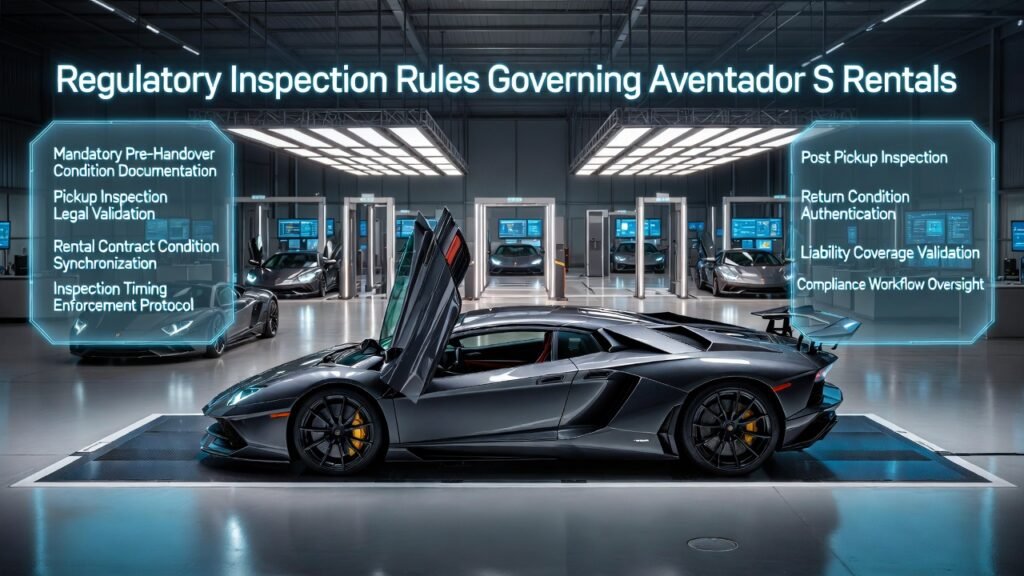
The regulatory layer of a Lamborghini Aventador S rental inspection checklist exists to standardize responsibility boundaries between renter and rental provider. These rules dictate how inspection data is collected, when it is validated, and who bears liability if inspection protocols are breached. Regulatory inspection rules are enforced indirectly through rental contracts, condition reports, and damage attribution clauses.
From an inspection standpoint, regulations require that all pre-existing conditions be documented before vehicle handover. Any undocumented issue discovered later is presumed to have occurred during the rental window. This makes inspection timing and completeness legally decisive. Additionally, inspection rules restrict unauthorized inspections after pickup; once the car leaves the pickup zone, inspection authority narrows significantly.
High-authority rental operations such as A to Z car rental Dubai integrate inspection checkpoints into regulated workflows, ensuring that inspection evidence remains contractually enforceable rather than discretionary.
Mandatory Inspection Compliance Rules (Point-Based)
The following rules define non-negotiable inspection compliance for Aventador S rentals. Skipping any point weakens renter protection.
- Inspection must be completed before key handover confirmation
- All inspection media must be time-stamped and sequential
- Vehicle condition report must mirror inspection observations exactly
- Carbon fiber surfaces require dedicated inspection notation
- Underbody inspection must be visually documented, not assumed
- Interior wear must be recorded regardless of severity
- Digital system status must be verified before vehicle movement
- Mileage and fuel level must be inspection-verified on record
Each rule operates as a liability shield, not a procedural formality.
Legal Responsibility Allocation Through Inspection Rules
Inspection rules are the primary mechanism through which legal responsibility is allocated. In Aventador S rentals, responsibility does not shift at ignition—it shifts at inspection acknowledgment. Once a renter signs the condition report, inspection findings become binding.
This is why inspection rules emphasize clarity over speed. Any ambiguity—unclear photos, missing angles, vague descriptions—defaults responsibility to the renter. Inspection rules also prohibit retrospective claims; damage cannot be added after the inspection acknowledgment unless supported by inspection evidence.
From a high-authority perspective, inspection rules exist to eliminate interpretive disputes. Clear inspection equals clear liability. Poor inspection creates contractual gray zones that almost always disadvantage the renter.
Mandatory Requirements for Inspection-Eligible Aventador S Rentals
A Lamborghini Aventador S rental inspection checklist can only be executed correctly when specific preconditions are met. These requirements are not rental eligibility requirements; they are inspection eligibility requirements.
To qualify for a valid inspection process, the rental must provide:
- A standardized condition report template
- Authorized inspection personnel or self-inspection allowance
- Adequate lighting and space for full vehicle inspection
- Permission to document all vehicle zones
- Matching documentation between vehicle and contract
Without these requirements, inspection outcomes lose enforceability, regardless of how thorough the renter attempts to be.
Renter-Side Inspection Readiness Requirements (Point-Based)
Before initiating inspection, renters must ensure readiness to execute the checklist correctly.
- Valid identification matching rental contract name
- Inspection-capable device with functional camera
- Sufficient time allocated before pickup completion
- Ability to review and amend condition report
- Understanding of inspection acknowledgment implications
- Access to rental agreement during inspection
- Willingness to delay pickup if inspection gaps exist
Inspection readiness is not optional; it directly determines dispute outcomes.
Inspection-Centered Booking Process Overview
The booking process, when viewed through an inspection lens, determines how much inspection control a renter will have. Many inspection failures originate during booking, not pickup.
Inspection-centered booking prioritizes:
- Transparent condition reporting policies
- Inspection documentation rights
- Pre-book disclosure of existing vehicle condition
- Defined inspection time windows
A booking that restricts inspection time or documentation authority undermines the checklist before it begins.
Step-by-Step Booking Process With Inspection Control
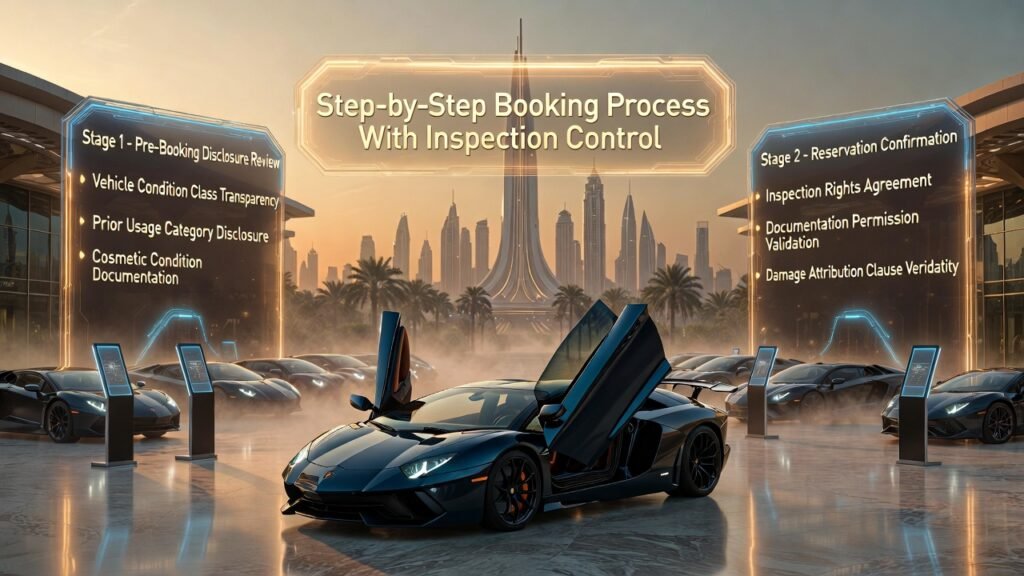
Each booking stage either strengthens or weakens inspection authority.
Stage 1: Pre-Booking Disclosure Review
Rental listings should disclose vehicle condition class, prior usage category, and cosmetic status. Absence of disclosure increases inspection burden.
Stage 2: Reservation Confirmation
Inspection rights, documentation permissions, and damage attribution clauses must be reviewed before payment confirmation.
Stage 3: Pre-Pickup Coordination
Confirm inspection location, lighting conditions, and allotted inspection duration.
Stage 4: Physical Pickup Inspection
Execute the Lamborghini Aventador S rental inspection checklist fully before key acceptance.
Stage 5: Condition Report Finalization
Ensure inspection findings are transcribed into the official report without dilution.
Booking-Linked Inspection Failure Risks
Inspection failures frequently trace back to booking-stage oversights. These risks include limited inspection windows, pre-signed condition reports, or verbal damage assurances.
High-risk booking indicators include:
- “Quick pickup” promises
- Pre-filled condition reports
- Inspection discouragement language
- Verbal-only damage acknowledgments
Avoiding these risks begins with inspection-aware booking decisions.
Inspection Authority Comparison Table (Booking Impact)
| Booking Type | Inspection Control | Liability Exposure |
|---|---|---|
| Instant Pickup Booking | Minimal | High |
| Standard Reservation | Moderate | Medium |
| Inspection-Centric Booking | Full | Low |
This comparison highlights how booking structure directly impacts inspection outcomes.
Inspection-Driven Trust Architecture in Premium Rentals
In high-value supercar rentals, trust is not emotional—it is procedural. The Lamborghini Aventador S rental inspection checklist functions as a trust architecture that replaces assumptions with verified condition data.
Rental platforms that publicly commit to inspection transparency, such as those operating under structured Lamborghini inspection workflows, allow renters to execute inspections without resistance. A practical reference for such inspection-aligned systems can be observed through this Lamborghini rental inspection framework used by A to Z car rental Dubai, where inspection integrity is embedded into the rental flow:
👉 https://lamborghiniurusrentaldubai.com/
Inspection Escalation Rights and Boundaries
Inspection rules also define when and how a renter can escalate inspection concerns. Escalation must occur before vehicle acceptance. Once the vehicle is moved, escalation rights narrow dramatically.
Valid escalation includes:
- Requesting additional inspection time
- Requesting supervisor verification
- Requesting report amendments
Invalid escalation includes post-return claims without pickup inspection proof.
Violation Attribution Logic in High-Value Supercar Rentals
Violation attribution is not emotional or opinion-based; it is logic-driven and rooted entirely in inspection evidence hierarchy. In Aventador S rentals, the system evaluates when a condition first appeared, whether it was documented, and how the condition aligns with known risk zones of the vehicle.
If inspection documentation is missing for a specific zone, the system presumes renter-period origin. If documentation exists but lacks clarity, liability is partially attributed. Full liability protection exists only when inspection evidence is clear, time-locked, and contract-linked.
This logic explains why two renters with identical damage outcomes can face completely different financial results. The difference lies in inspection completeness, not behavior.
Damage Classification System Used After Inspection
Damage is not treated as a single category. Inspection systems classify damage using a tiered taxonomy to calculate penalties.
Primary classification layers include:
- Cosmetic surface deviation
- Structural material compromise
- Functional component impairment
- Safety-adjacent system interference
Each layer carries different financial weight. A cosmetic carbon fiber scuff documented at pickup carries zero renter liability, while an undocumented micro-crack is classified as structural risk. Inspection determines which classification applies.
Understanding this system reinforces why precise inspection language matters more than general descriptions.
Inspection Language That Triggers Penalty Escalation
Not all inspection notes are equal. Certain language automatically escalates damage classification.
High-risk inspection terms include:
- “Unverified”
- “Possible”
- “Minor but unclear”
- “Requires further assessment”
Such language invites post-return escalation. High-authority inspection practice replaces ambiguous phrasing with observable condition statements. Precision in inspection notes directly suppresses penalty escalation.
Financial Penalty Triggers Tied to Inspection Gaps
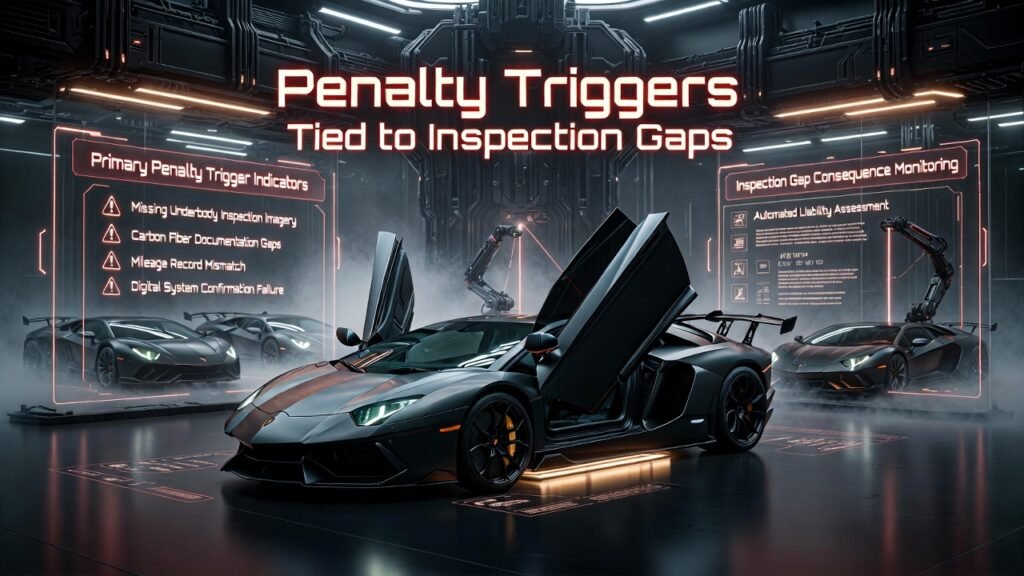
Penalties are rarely triggered by damage alone. They are triggered by inspection gaps.
Primary penalty triggers include:
- Missing underbody inspection imagery
- Incomplete carbon fiber documentation
- Mismatched mileage records
- Absent digital system confirmation
- Pre-signed condition reports
When any of these gaps exist, penalty algorithms assume adverse conditions. This is why inspection gaps often cost more than actual damage severity.
Inspection Bias and How It Forms
Inspection bias occurs when post-rental assessors interpret damage without baseline neutrality. Bias forms when inspection records lack scale, context, or comparators.
Bias is amplified by:
- Single-angle photographs
- Lack of close-range and wide-range pairing
- No reference to adjacent unaffected areas
- Absence of prior-condition comparison
Inspection bias does not imply malice; it arises from incomplete evidence. The checklist exists to eliminate bias vectors before they form.
Bias-Control Inspection Techniques (Point-Based)
These techniques neutralize inspection bias before return evaluation.
- Capture identical zones from multiple consistent angles
- Pair close-up images with wide contextual frames
- Include unaffected adjacent surfaces for comparison
- Maintain uniform lighting conditions across inspection media
- Use neutral descriptors instead of evaluative language
- Reference physical landmarks in documentation
- Ensure image sequencing matches inspection flow
Bias control transforms inspection data into defensible evidence.
Damage Aging Analysis and Inspection Timing
Advanced inspection systems evaluate damage aging—the estimated duration a condition has existed.
Indicators include:
- Oxidation presence
- Edge softening on carbon fiber
- Dust integration patterns
- Heat exposure discoloration
Inspection performed early captures aging indicators that later exonerate the renter. Late or rushed inspections eliminate this protection.
Comparative Damage Outcome Table (Inspection Impact)
| Inspection Quality | Damage Found | Financial Outcome |
|---|---|---|
| Minimal | Minor scuff | High penalty |
| Standard | Same scuff | Reduced penalty |
| Advanced checklist | Same scuff | No penalty |
This table demonstrates that inspection depth, not damage size, determines outcome.
Inspection Record Retention Strategy
Inspection evidence must survive beyond vehicle return.
Retention strategy includes:
- Cloud-backed duplication
- Immutable file storage
- Organized zone-based labeling
- Retention duration aligned with contract
Without retention, even perfect inspection becomes useless in disputes.
Rental Provider Inspection Bias Indicators
Certain behaviors signal elevated inspection bias risk.
Indicators include:
- Rushed return inspections
- Refusal to compare pickup records
- Emphasis on undocumented zones
- Selective image presentation
Recognizing these indicators allows renters to assert inspection rights immediately.
Inspection Escalation Safeguards
When disputes arise, inspection safeguards activate only if inspection integrity exists.
Safeguards include:
- Cross-referencing pickup documentation
- Demonstrating aging inconsistency
- Highlighting documentation asymmetry
These safeguards collapse if inspection was weak at the start.
Trust Engineering Through Inspection Transparency
In premium ecosystems, trust is engineered through procedural transparency, not verbal assurance. Rental operations that embed inspection transparency into their workflows reduce disputes and accelerate resolution.
A practical benchmark for inspection-aligned transparency can be observed in inspection-first Lamborghini rental systems, where condition reporting, inspection acknowledgment, and documentation integrity are structurally linked rather than optional. A reference framework reflecting this approach is visible here:
👉 https://lamborghiniurusrentaldubai.com/
Final Inspection Intelligence Insight
At the highest level, a Lamborghini Aventador S rental inspection checklist is not a checklist—it is a risk translation system. It converts visual reality into contractual truth. Those who understand inspection logic control outcomes; those who treat inspection casually inherit liability.
Why is a Lamborghini Aventador S rental inspection checklist more critical than standard supercar inspections?
A Lamborghini Aventador S rental inspection checklist is critical because the Aventador S operates at a significantly higher material, financial, and liability threshold than most supercars. Its extensive carbon fiber construction, low aerodynamic profile, and electronically adaptive systems mean that even minor undocumented conditions can translate into major post-rental claims. Unlike standard inspections that focus on surface-level checks, Aventador S inspections must establish baseline condition truth that is contractually defensible. In high-value rentals, inspection quality directly determines deposit outcomes, dispute resolution speed, and liability attribution.
At what exact moment does inspection responsibility legally transfer to the renter?
Inspection responsibility transfers only after the renter formally acknowledges the condition report, not when the engine is started or the keys are handed over. This distinction is crucial. If inspection documentation is incomplete or inaccurate at the moment of acknowledgment, responsibility still transfers—placing liability on the renter. This is why inspection must be completed, verified, and synchronized with the contract before acceptance. Once acknowledgment occurs, undisclosed conditions are presumed renter-caused unless inspection evidence proves otherwise.
Can inspection photos alone protect a renter from damage claims?
Inspection photos protect a renter only when they meet evidentiary standards. Random or low-quality images are insufficient. Effective inspection photos must be time-stamped, sequential, clearly framed, and contextually anchored to identifiable vehicle zones. They must also align with written inspection notes and the official condition report. Photos without supporting documentation or unclear image sequencing often fail during dispute evaluation. The checklist emphasizes inspection evidence architecture, not just photo quantity.
How does underbody inspection influence Aventador S rental disputes?
Underbody inspection is one of the highest-impact elements of the Lamborghini Aventador S rental inspection checklist. Because underbody contact is common due to low clearance, disputes frequently arise from undocumented scrapes or aero tray abrasions. If underbody inspection imagery is missing at pickup, post-return damage is almost always attributed to the renter. Conversely, clear underbody documentation at pickup neutralizes most claims instantly. This single inspection area can determine whether a dispute escalates or ends immediately.
Conclusion — Final Authority Perspective
The Lamborghini Aventador S rental inspection checklist is not a routine checklist, nor a formality—it is a risk governance system. Across this article, inspection has been treated as a layered process: visual verification, documentation integrity, regulatory alignment, booking-stage control, damage classification logic, and bias suppression. Each layer exists to convert physical vehicle condition into contractual certainty.
In high-value supercar rentals, outcomes are not decided by intention, driving behavior, or verbal assurances. They are decided by inspection evidence quality. A renter who understands inspection architecture controls liability; a renter who treats inspection casually inherits uncertainty.
When executed correctly, the checklist transforms inspection from a reactive defense into a proactive authority tool—ensuring transparency, fairness, and financial protection in one of the most demanding rental environments in the automotive world.