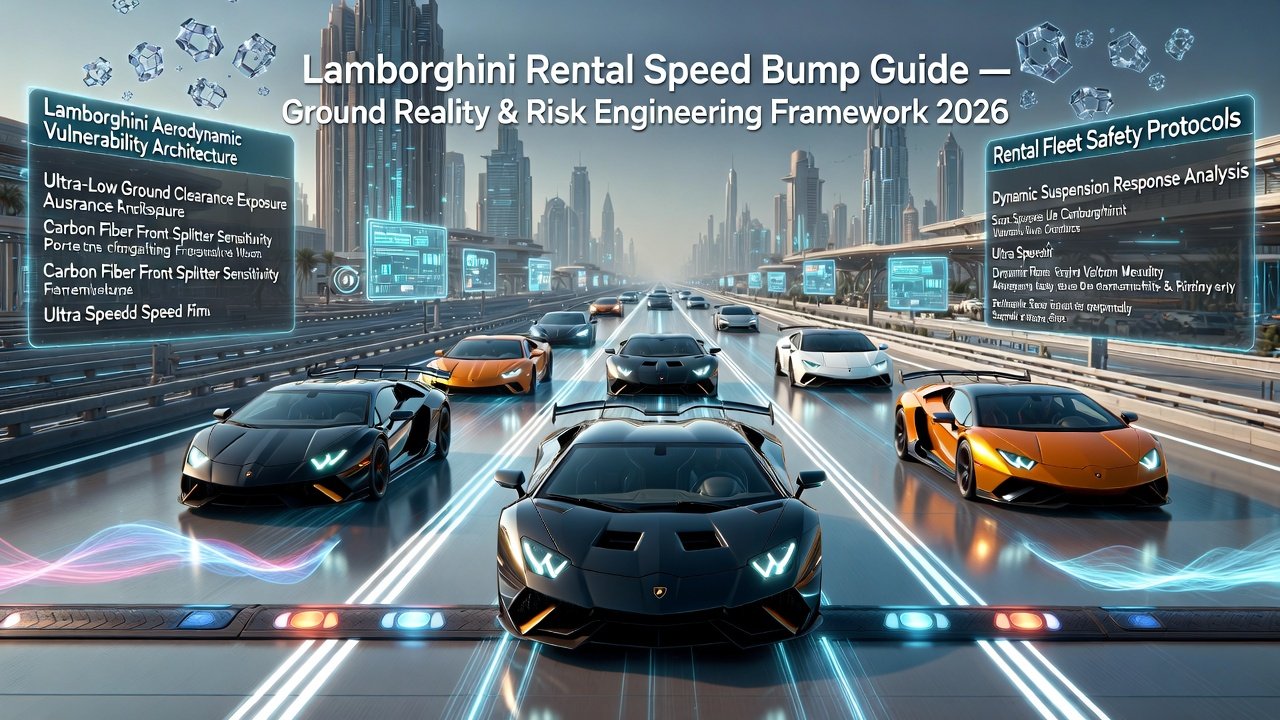
Lamborghini rental speed bump guide is not a casual driving topic; it is a damage-prevention framework built around ultra-low ground clearance, carbon fiber aero geometry, and rental liability exposure. In the rental environment, speed bumps represent the single most frequent cause of underbody damage, front splitter cracks, and post-return disputes. Unlike standard vehicles, Lamborghinis are engineered with performance-first aerodynamics, not obstacle tolerance. This guide begins by establishing the technical and rental-specific reality of speed bumps, explaining why they pose a disproportionate risk and why renters must treat them as controlled hazards rather than routine road features.
Why Speed Bumps Are a Critical Threat in Lamborghini Rental Speed Bump
Speed bumps interact directly with the lowest structural and aerodynamic points of a Lamborghini. Front splitters, undertrays, and diffuser edges sit far lower than conventional vehicles, leaving minimal clearance margin. In a rental scenario, this risk is amplified because any contact—no matter how light—can translate into financial liability if not managed correctly.
Unlike potholes, speed bumps are intentional, predictable obstacles, which means damage is often classified as avoidable by rental assessors. This classification shifts responsibility heavily toward the renter. From a high-authority perspective, speed bump awareness is not about driving comfort; it is about risk attribution. Rental providers assess speed bump damage differently from random road hazards, making this guide essential for liability control.
Lamborghini Aerodynamic Geometry and Speed Bump Interaction
Lamborghinis are designed around active aerodynamics, fixed carbon fiber components, and aggressive approach angles. The front approach angle is especially shallow, meaning the nose reaches the speed bump before the wheels elevate the chassis. This mechanical sequence is what causes splitter contact even at low speeds.
Additionally, many Lamborghini models use extended aero elements that protrude forward and downward. These elements are not flexible; they are rigid carbon fiber structures designed for airflow precision. When they meet a speed bump, they do not compress—they scrape, crack, or delaminate. In rental fleets, these components represent some of the highest repair costs, which is why speed bump damage receives immediate attention during return inspections.
Lamborghini Rental Speed Bump Liability Logic Behind Speed Bump Damage

In Lamborghini rentals, speed bump damage is rarely treated as accidental. Rental liability frameworks often categorize such damage under controlled-environment incidents, meaning the renter is expected to anticipate and manage the obstacle. This is a crucial distinction.
If underbody or splitter damage appears after a rental and there is no pickup documentation proving pre-existing wear, the damage is almost always attributed to renter behavior. This is why a Lamborghini rental speed bump guide exists at all: it addresses a risk that is predictable, common, and financially significant.
High-authority rental platforms structure their condition reports and inspections with speed bump exposure in mind, especially in urban environments where such obstacles are unavoidable.
Lamborghini Rental Speed Bump Urban Infrastructure vs Supercar Design Mismatch
Modern urban infrastructure prioritizes traffic calming, not supercar compatibility. Speed bumps vary widely in height, angle, and material—often without standardization. This unpredictability is especially dangerous for Lamborghini rentals.
Some speed bumps are shallow but wide, while others are steep with sharp leading edges. Lamborghinis are vulnerable to both types, but for different reasons. Wide bumps increase undertray contact duration, while steep bumps concentrate impact at the splitter edge. Rental damage assessments do not differentiate between bump types; they only evaluate outcome. Understanding this mismatch is foundational to speed bump risk management.
Lamborghini Rental Speed Bump Underbody Exposure Zones Most Affected by Speed Bumps
Speed bumps do not affect the entire vehicle equally. Specific zones face repeated exposure during rental use.
Primary exposure zones include:
- Front splitter leading edge
- Lower front bumper lip
- Undertray mounting points
- Mid-chassis aero trays
- Rear diffuser entry angle
Damage in these zones is often subtle at first but escalates with repeated contact. Rental inspections are trained to focus on these areas, making speed bump awareness directly tied to inspection outcomes.
Why Rental Lamborghinis Are More Vulnerable Than Owned Vehicles
Owned Lamborghinis are typically driven on familiar routes, by owners who understand clearance limits intimately. Rental Lamborghinis, by contrast, are driven on unfamiliar roads, by users who may underestimate obstacle height or overestimate clearance.
Additionally, rental vehicles cycle through multiple users, increasing cumulative wear risk. A single poorly managed speed bump crossing can expose existing micro-damage and turn it into visible failure. Rental assessors then attribute the final visible damage to the last renter unless evidence proves otherwise.
This reality explains why professional Lamborghini rental environments emphasize structured guidance and awareness. A reference example of such high-standard Lamborghini rental operations—where risk education and vehicle preservation are integrated into the rental ecosystem—can be observed here:
👉 https://lamborghiniurusrentaldubai.com/
Lamborghini Rental Speed Bump Speed Bumps as a Deposit Risk Multiplier
From a financial perspective, speed bumps act as deposit risk multipliers. Even minor contact can trigger inspection flags, secondary assessments, and repair estimates. Because carbon fiber repairs are specialized, costs escalate quickly—even for cosmetic damage.
Rental agreements often allow providers to hold deposits until damage classification is complete. Speed bump-related damage extends this process more than almost any other incident type. This makes speed bump management one of the highest-impact behaviors affecting deposit release timelines.
Lamborghini Rental Speed Bump Foundational Insight for Renters (Authority Signal)
The most important foundational insight is this:
Speed bumps are not driving obstacles; they are inspection triggers.
Treating them casually is the fastest way to turn a premium Lamborghini rental experience into a financial dispute. Treating them as controlled risk points is how professional renters preserve both the vehicle and their deposit.
Approach Angles and Vehicle Geometry
The approach angle is the critical factor when encountering any speed bump in a low-clearance Lamborghini. The Aventador’s front splitter sits extremely low, and the effective angle of attack determines whether the front edge will contact the bump.
Key principles:
- Always approach diagonally when width allows, distributing lift across the wheels
- Avoid full frontal impact with steep bumps to prevent splitter scraping
- Observe suspension compression visually before attempting steep ascents
- Reduce speed to maintain dynamic control while maximizing ground clearance
- Anticipate uneven bump surfaces to prevent undertray contact
Proper angle management directly reduces inspection-triggered damage in rental environments.
Lamborghini Rental Speed Bump Suspension Dynamics and Adaptive Response
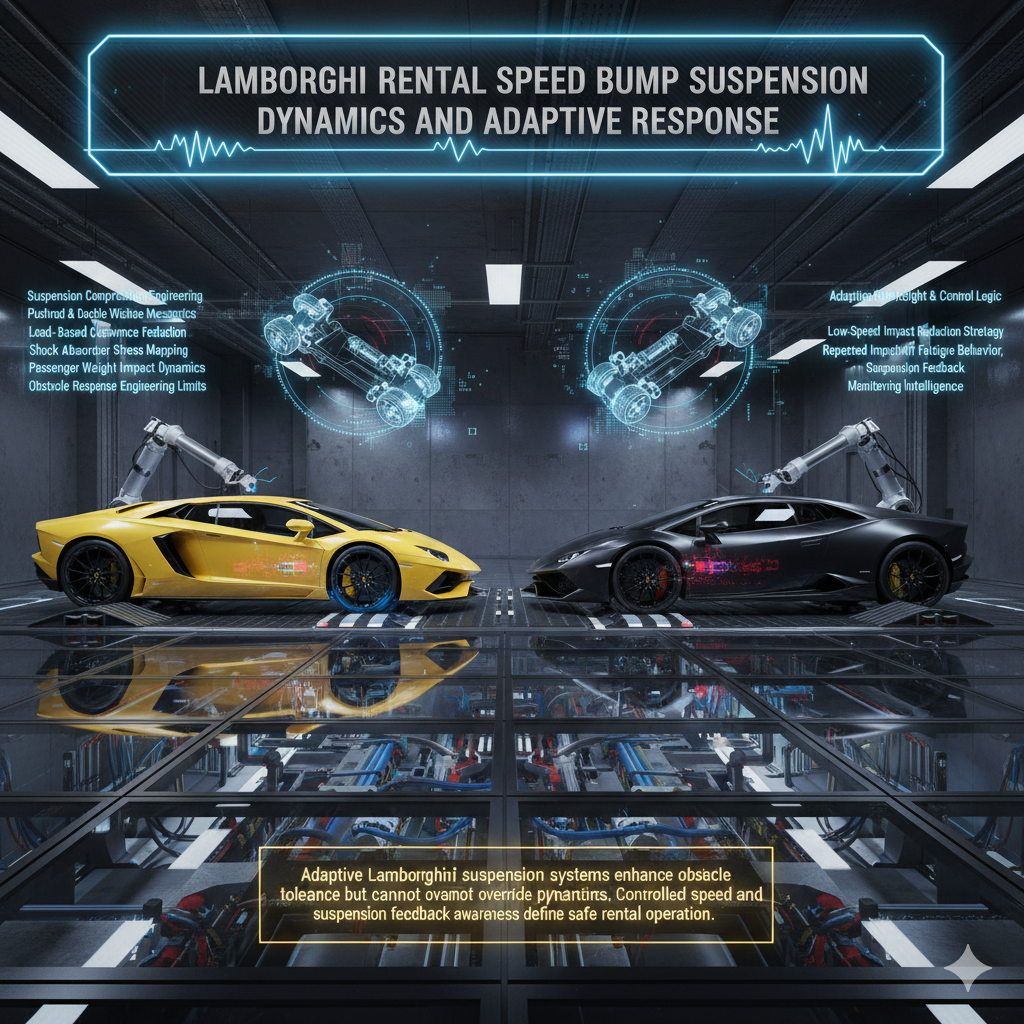
Modern Lamborghinis use pushrod or double-wishbone suspension systems with active adaptive capabilities. During rental use, these systems offer limited additional clearance, but misuse or high-speed traversal can exceed design limits.
Practical insights:
- Suspension compresses under load; slowing to 5–8 km/h per bump reduces impact
- Active ride-height adjustments may be limited if nose-lift is inactive
- Excessive weight in passenger area reduces effective bump clearance
- Repeated minor impacts can accelerate wear on shock absorbers and bushings
- Suspension feedback should guide speed adjustment, not intuition alone
Understanding how adaptive suspension interacts with obstacles is a core competency for professional Lamborghini renters.
Lamborghini Rental Speed Bump Nose-Lift System Utilization
Many Aventador models include an active nose-lift system. Proper usage dramatically reduces speed bump risk. In rental vehicles, using nose-lift is often mandated by rules to preserve aerodynamic components.
Guidelines:
- Engage nose-lift fully before approaching steep or unknown bumps
- Verify system responsiveness during pre-rental inspection
- Do not exceed nose-lift limits; aggressive entry angles can still cause minor scraping
- Combine nose-lift with slow, diagonal approach for maximum clearance
- Confirm nose-lift is retracted before high-speed segments to avoid stability compromise
Rental providers increasingly integrate nose-lift usage into their inspection checklists, documenting compliance to protect renters from liability.
Lamborghini Rental Speed Bump Real Rental Damage Patterns from Speed Bumps
Post-rental inspections consistently highlight recurring damage zones from improper speed bump navigation:
- Front splitter leading-edge cracks
- Undertray scrapes and mounting clip failure
- Front bumper lip delamination
- Rear diffuser minor contact from ramp-like bumps
- Minor paint scuffs along side skirts due to diagonal misalignment
These patterns are predictable and preventable, forming the basis for high-authority renter guidance. Proper technique mitigates nearly all recurring issues, and inspection teams routinely flag incidents in these zones first.
Lamborghini Rental Speed Bump Practical Risk Mitigation Strategies
Professional Lamborghini renters adopt a risk-mitigation framework to navigate speed bumps:
- Scan roads in advance for bumps and obstacles
- Reduce speed to a controlled crawl for unknown or steep bumps
- Use diagonal traversal when road width permits
- Engage nose-lift systems wherever available
- Monitor suspension feedback continuously during traversal
- Document road conditions when using high-profile urban routes
- Avoid parking areas with high bump density unless necessary
Applying these strategies reduces potential inspection claims, preserves vehicle integrity, and protects security deposits.
Lamborghini Rental Speed Bump High-Authority Rental Insight
Top-tier Lamborghini rental operators, such as A to Z car rental Dubai, embed speed bump awareness into the rental workflow. They educate renters on approach techniques, suspension response, and nose-lift usage, ensuring that inspection outcomes remain favorable and that vehicles maintain structural and aesthetic integrity:
👉 https://lamborghiniurusrentaldubai.com/
This proactive approach transforms speed bump navigation from a liability risk into a controlled and professional driving behavior.
Core Rules Governing Speed Bump Navigation
Speed bumps are a high-risk factor in Lamborghini rentals. Operators enforce specific rules to prevent damage:
- Always approach at or below the designated speed limit (typically 5–8 km/h)
- Diagonal approach is mandatory for steep or unfamiliar bumps
- Nose-lift must be activated when available
- Roof and aerodynamic component adjustments must be observed for clearance
- Vehicle must not traverse bumps carrying excessive load
- Post-bump inspection is required for high-risk areas
- Any damage must be reported immediately
These rules ensure consistent inspection outcomes and minimize liability attribution to renters.
Renter Requirements for Speed Bump Compliance
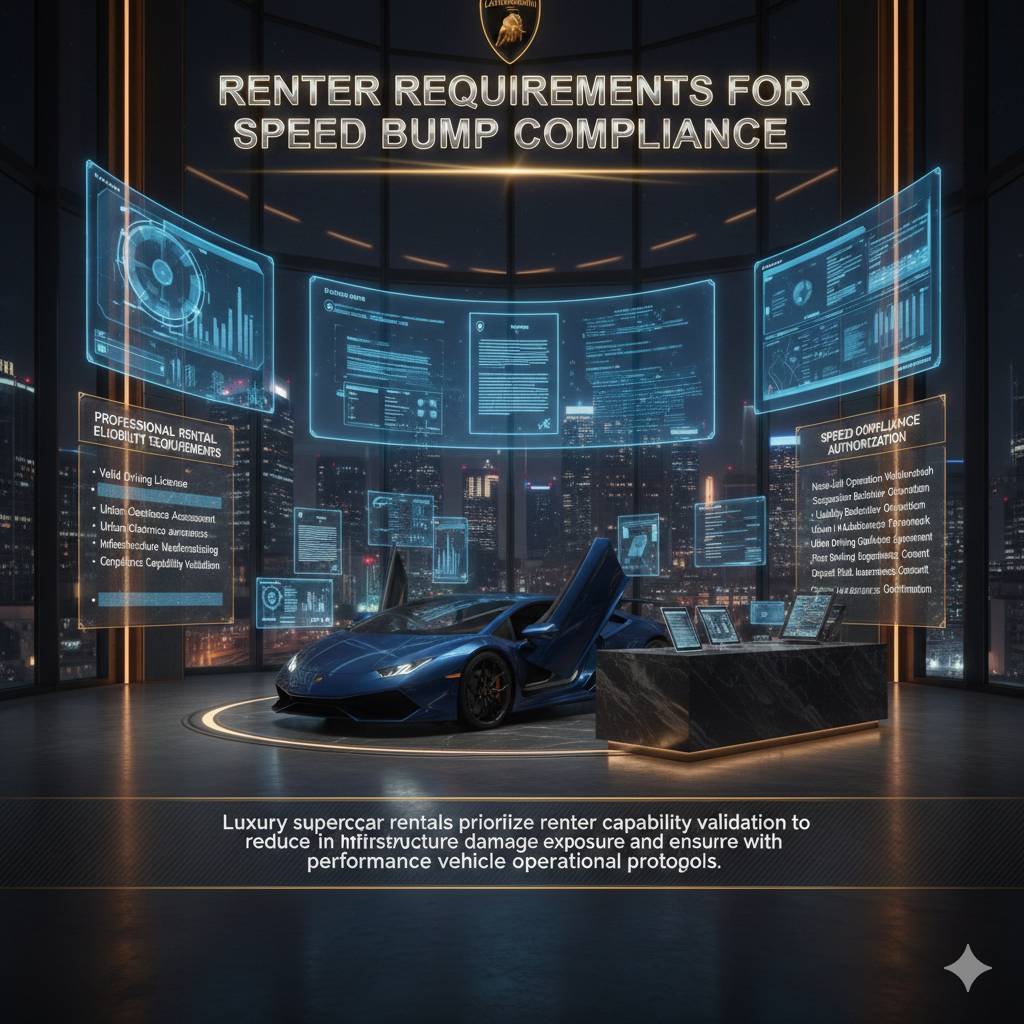
Professional rentals evaluate renter capability, not just eligibility for payment. Requirements include:
- Valid driving license verified against rental regulations
- Prior supercar rental experience or demonstrated clearance awareness
- Acknowledgment of speed bump rules and liability framework
- Pre-rental walkthrough of nose-lift operation and suspension behavior
- Agreement to comply with urban infrastructure navigation protocols
- Consent to post-rental inspection and documentation procedures
- Understanding of deposit implications for speed bump-related incidents
These requirements reduce post-return disputes and align renter behavior with high-value vehicle preservation.
Booking Integration for Speed Bump Awareness
Modern Lamborghini rental platforms integrate speed bump awareness into booking workflows. This ensures renters are prepared before taking possession of the vehicle:
- Pre-Booking Disclosure – Vehicle-specific clearance data, nose-lift instructions, and common obstacle advisories are presented.
- Reservation Validation – Renter confirms understanding of rules and acknowledges inspection procedure.
- Pickup Scheduling – Inspection time includes orientation on underbody, splitter, and suspension-sensitive zones.
- Inspection Alignment – Road-specific recommendations, including speed bump hotspots, are incorporated into pre-rental documentation.
This structured integration preserves inspection integrity and reduces liability exposure. A practical example of high-standard rental workflow is available here:
👉 https://lamborghiniurusrentaldubai.com/
Speed Bump Violation Penalties
Violations during rental are categorized based on risk severity and inspection evidence:
| Violation Type | Example | Penalty Outcome |
|---|---|---|
| Minor contact | Light splitter scrape with photo documentation | Security deposit adjustment, no major penalty |
| Moderate contact | Underbody scuff with minor structural risk | Partial repair charge + deposit deduction |
| Major contact | Carbon fiber crack or splitter delamination | Full repair cost + extended deposit hold |
| Repeated offenses | Multiple documented impacts | Rental blacklist consideration + full liability |
Penalty frameworks are designed to reinforce compliance and protect rental assets.
Advanced Risk Comparison — Coupe vs Roadster vs SVJ
| Feature | Coupe | Roadster | SVJ |
|---|---|---|---|
| Ground Clearance | Standard | Low | Ultra-low |
| Nose-Lift Requirement | Optional | Recommended | Mandatory |
| Inspection Sensitivity | Moderate | High | Extreme |
| Speed Bump Exposure Risk | Medium | High | Maximum |
| Liability Escalation | Moderate | High | Very High |
| Rental Deposit Impact | Medium | High | Critical |
This comparison clarifies why structured speed bump guidance is non-negotiable for Roadster and SVJ rentals.
Practical High-Authority Insight
Professional Lamborghini rental operators, such as A to Z car rental Dubai, implement:
- Renter education on speed bump dynamics
- Inspection-aligned pickup and return protocols
- Documented nose-lift and suspension usage checks
- High-resolution inspection photography for underbody zones
- Structured deposit and penalty frameworks
By embedding these systems, rentals transform avoidable risk points into controlled, transparent, and professional driving experiences:
👉 https://lamborghiniurusrentaldubai.com/
Final Takeaway — Authority and Attention Capture
Speed bumps are the single largest avoidable liability in Lamborghini rentals. Managing them requires expert awareness, inspection-aligned booking, and strict compliance with high-authority rules.
The Lamborghini rental speed bump guide is more than a manual; it is a risk management framework that integrates:
- Approach strategy and angle science
- Suspension and nose-lift dynamics
- Inspection-focused renter behavior
- Structured rules, booking integration, and penalty frameworks
Following this guide ensures that the Lamborghini rental experience remains thrilling, safe, and dispute-free, protecting both the vehicle and the renter’s financial and reputational interests.
Why are speed bumps the most critical hazard in Lamborghini rentals?
Speed bumps represent a predictable yet high-risk obstacle for Lamborghinis due to extremely low ground clearance, rigid carbon-fiber aero elements, and shallow approach angles. Unlike potholes or debris, speed bumps are considered avoidable obstacles, meaning rental liability often falls on the driver if proper technique is not followed. Awareness and adherence to approach angles, speed limits, and nose-lift usage are crucial to prevent financial and inspection-related consequences.
How does nose-lift usage reduce risk on speed bumps?
The Aventador’s nose-lift system provides additional clearance at the front splitter and underbody, effectively preventing contact with elevated obstacles. Proper use involves activating the system before the bump, combining it with a slow, diagonal approach, and monitoring suspension feedback. In high-authority rentals, nose-lift compliance is often documented in inspection checklists, protecting the renter from liability for minor contact incidents.
What approach techniques minimize speed bump damage?
Key approach techniques include:
Diagonal crossing when road width permits
Maintaining ultra-low speeds (5–8 km/h for unknown bumps)
Monitoring suspension compression and nose-lift engagement
Avoiding full-frontal contact with steep or irregular bumps
Observing bump height before traversal
Following these techniques reduces damage risk to underbody components, splitter, and diffuser, and improves inspection outcomes.
Are speed bump-related damages treated differently in rentals than other road incidents?
Yes. Speed bump damage is often classified as controlled-environment damage, meaning it is considered avoidable. Rental assessors typically assign liability to the renter unless clear evidence proves the vehicle was already compromised. This is why pre-rental documentation, post-pickup inspection, and photographic evidence are emphasized by high-authority rental operators.
Conclusion — Lamborghini Rental Speed Bump Authority
Speed bumps are not just minor road obstacles; they are high-stakes risk factors in Lamborghini rentals. Effective management combines technical knowledge, pre-rental preparation, and compliance with high-authority rules.
The Lamborghini Rental Speed Bump Guide demonstrates that success in rentals requires:
- Mastery of approach angles and speed control
- Proper use of adaptive suspension and nose-lift systems
- Pre-rental and post-rental inspection compliance
- Awareness of deposit and liability frameworks
- Following structured, platform-guided rental rules
By integrating these elements, renters minimize liability, protect the vehicle, and maintain a premium, dispute-free experience. In 2026, authority in Lamborghini rentals is defined not by horsepower alone, but by structured risk management and process mastery, ensuring that every speed bump becomes a controllable, safe, and professional part of the supercar experience.